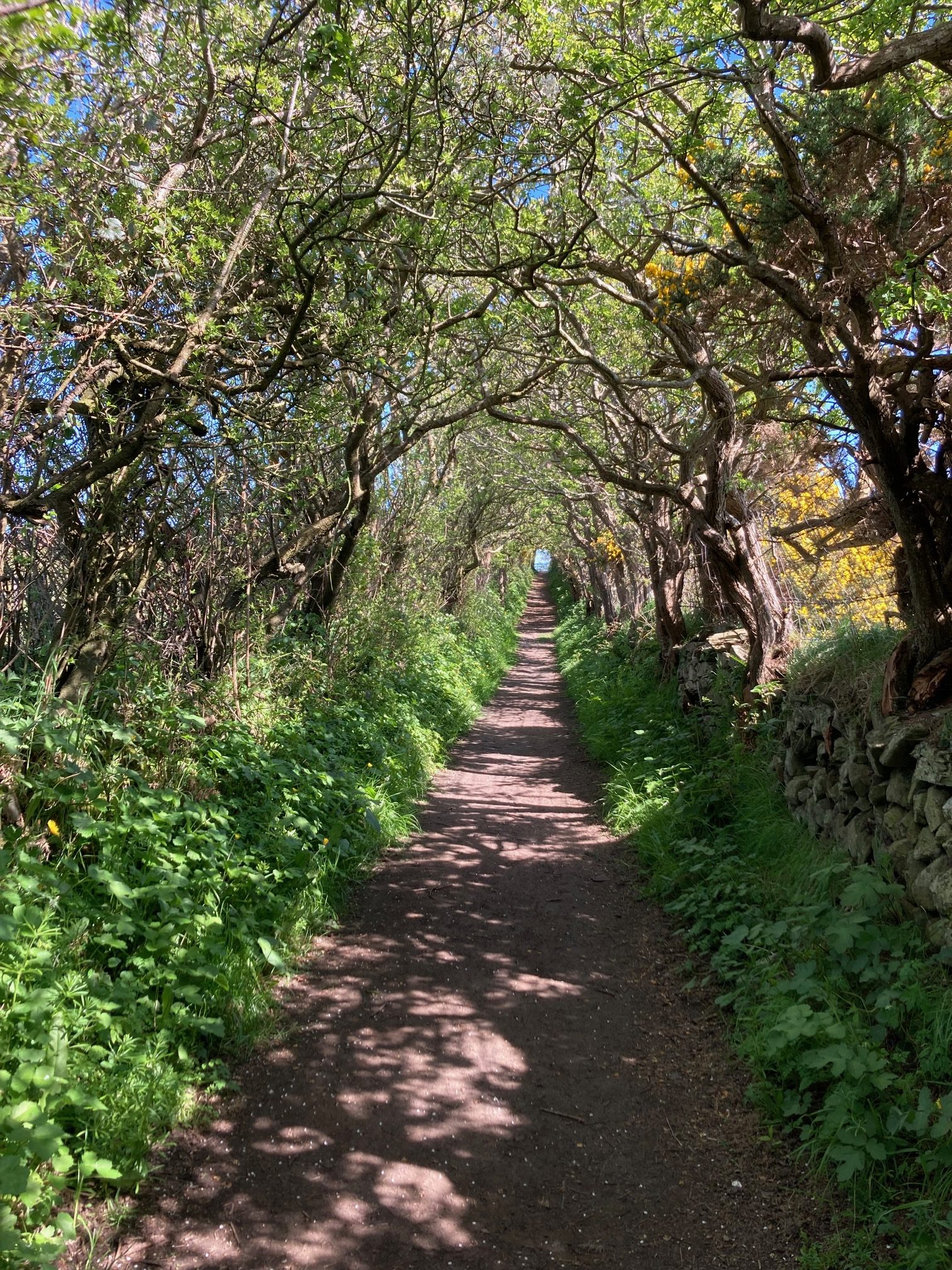
Doorways to Other Worlds
The approach to Ballynoe Stone Circle in County Down is a long tunnel of ancient trees, branches arching overhead, light pooling at the far end. Something about it slows you down without asking. You arrive at the stones differently than you arrived at the gate.
Which is perhaps the point.
The ancient Irish understood these places as doorways. Thresholds where the veil between this world and the Otherworld was thin enough to push through. The Tuatha Dé Danann — that divine race who retreated underground when the world changed — could still be reached here. Time behaved differently. Those who lingered risked being taken.
Or returned changed.
The stones themselves are enormous. Lichen-covered, settled deep into the earth, standing in a field scattered with daisies and dandelions. Impressive in the way genuinely ancient things are impressive — not dramatically, not theatrically, but with a quiet weight that accumulates the longer you stand with them.
And yet — something honest needs saying.
Standing inside most stone circles in daylight the ancient pull is surprisingly faint. Diluted somehow. Used up perhaps by the centuries of ordinary life that have flowed around and through these places. Farmers ploughing. Children playing. The indifferent accumulation of ordinary days pressing down on the extraordinary.
Beaghmore in the Sperrins is the exception. Seven stone circles, ten stone rows, twelve cairns — the whole complex lying under peat for millennia until turf cutting in the 1940s revealed it. Emerged from the ground. Came back. Visited at night. Halloween night, as it happened. Standing inside Beaghmore in the dark on the eve of Samhain — the one night of the year the ancient Irish believed the doors between worlds stood open — is a different experience entirely. The darkness gives the stones back something the daylight takes from them.
Something that might be — presence.
Drumskinny in Fermanagh. Thirty nine stones on wild open ground once an old bog, off Rotten Mountain Road, dating to around 2250 BC. Not easy to find — had to ask a local. Windswept, remote. Stood inside it. Felt the wind. Tried to imagine four thousand years of the same wind on the same stones.
Aghanaglack court tomb — also in Fermanagh, also in forest, also not easy to find. A dual court tomb built from enormous limestone slabs. Between four and six thousand years old. When excavated in 1938 the finds included fragments of burned bone — children — and the burned remains of a youth.
It had also, at some point, been used as a pigsty.
Earlier unofficial excavations by local people were abandoned when the diggers were scared off by the appearance of an enormous cat.
The name means — field of the hollow.
What were they for? Nobody knows with certainty. Astronomy perhaps. Burial certainly. Ritual almost certainly.
But the tradition is specific about one thing. These were liminal places. Points in the landscape where the Otherworld pressed closest. Where the dead could still be reached. Where those who came with intention — and left something — might receive something in return.
The stones are still standing.
The doorways are still open.