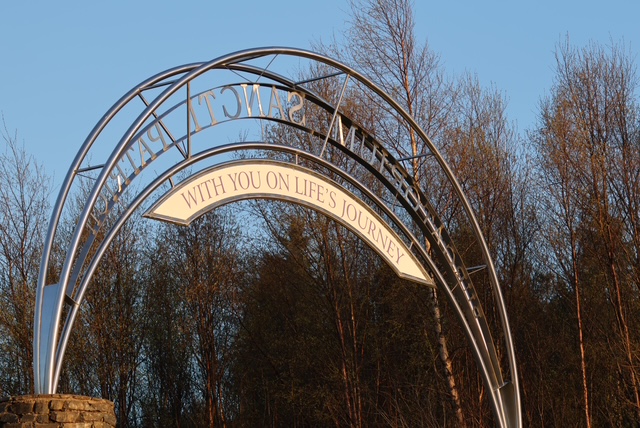
Purgatory — Is It Really on a Map?
There is a small arrow on a country road in Donegal. It says Lough Derg. Nothing else. No indication that what lies at the end of it is one of the most consequential sites in the history of Western religion.
Because here is what came from a cave on a small island in a dark bog lake in ancient Ulster.
Purgatory.
Not the concept — that had been argued over by theologians for centuries. The word itself. The named, defined, physical place between heaven and hell where the ordinary, flawed soul gets cleaned up before entry. That came from here. From this bog. From one night in one cave. From one man.
And it changed everything.
To understand why, you have to understand the problem the medieval Church had.
Heaven and hell are a binary. You are good enough or you are not. But most people are neither saint nor monster — they are somewhere muddily in between. Ordinary. Flawed. Trying. The binary offered them nothing except anxiety.
Purgatory solved that. It said, 'You don't have to be perfect.' There is a place after death where the soul is purified before entry into heaven. A second chance. Not salvation by perfection but salvation by process.
The theology had been circulating for centuries. But it was abstract. A state. A concept without an address.
Then an Irish knight called Owein went into a cave.
Owein had fought in the Crusades. He had crossed the known world, killed people, survived things that should have killed him, and come home to Ireland carrying all of it. Ordinary confession couldn't touch what he was carrying. Ordinary penance felt insufficient for what he had done.
He already knew about the cave. Every man in ancient Ulster knew about the cave. It had been there since the fifth century — a place of extreme penance on a small island in a dark bog lake. The most difficult thing available. The place you went when nothing else was enough.
So he went.
He confessed to a bishop first. The penance prescribed felt too light. He asked instead for the cave. Both his bishop and the prior of the pilgrimage tried to dissuade him. He persisted until they relented.
For fifteen days he fasted and prayed in preparation. Fifteen days of barely eating. Fifteen days of sleep deprivation and mounting dread of what was coming. On the sixteenth morning, in solemn procession, the monks led him to the cave entrance — narrow as a confession, dark as a grave — and locked him inside.
He was told that if he was not there when the door opened the following morning, it would be assumed he was dead.
What happened in those twenty-four hours is worth considering carefully.
Owein had been fasting for over two weeks. He had barely slept. He was alone in a space barely wide enough to kneel in, in complete darkness, with no food, no water, and no light. A man already broken open by years of crusading violence, alone in the dark with everything he had done.
A brain in that condition — starved of glucose, starved of sleep, starved of sensory input — will begin generating its own experience. Visions are not just possible in those circumstances. They are physiologically inevitable.
Owein saw demons with iron hooks. Fields of fire. Souls nailed to the ground. A bridge over an abyss so narrow only the pure in heart could cross it.
He crossed it. He emerged. He became a monk — put down his sword, his violence, and his old life — and entered a monastery. Whatever happened in that cave, it worked. He was changed.
Years later an English monk called Gilbert arrived in Ireland needing an interpreter. Owein – bilingual, now monastic, still carrying the cave — was introduced to him. During their time together Owein told Gilbert what had happened in the dark.
Gilbert took the story back to England. He told a Cistercian monk called Henry of Saltrey. Henry wrote it down – the Tractatus de Purgatorio Sancti Patricii, the Treatise on Saint Patrick's Purgatory – sometime around 1180.
Henry had never been to Lough Derg. He had never met Owein. He was writing down a story he had heard from a man who had heard it from the man it happened to. Thirty years and three tellings between the cave and the page.
It didn't matter. The story was exactly what Europe needed.
The Tractatus spread like nothing before it. Over 150 Latin manuscripts survive. Over 300 translations and adaptations in almost every European language — French, Spanish, Italian, Provençal, Middle English, and Sicilian. Marie de France translated it into French and made it a bestseller across the continent. It was one of the most widely read texts of the entire Middle Ages.
Because it gave purgatory an address.
Suddenly the abstract theological concept had geography. A cave. An island. A dark lake in the northwest corner of Ireland. You could find it on a map. You could go there. You could experience purgatory while still alive and come back.
For a twelfth-century reader who believed the veil between the physical and spiritual world was genuinely thin, this was not fantastical. This was simply directions.
And so they came. From Hungary, from Spain, from France, from Italy. On foot. Weeks on the road. Guided by what they had been told by those who went before. All of them making for a small dark island in a bog at the edge of the known world, to be locked alone into a cave and confront whatever lived in the dark.
Dante almost certainly knew the Tractatus. It was everywhere. Whether he read it directly or absorbed it through a culture saturated by it for a century — the architecture of the Divine Comedy carries its mark. The geography of purgatory. The descent and the return. The bridge. The climb toward paradise.
And Shakespeare knew about it too. In Hamlet, the Prince of Denmark invokes Saint Patrick when his father's ghost appears — the clear implication being that the soul has been released momentarily from purgatory to speak to his son.
A cave in a bog in Donegal is in Hamlet.
The greatest literary work of the Middle Ages and the greatest literary work of the English Renaissance. Both carrying the fingerprints of one Irish knight's night in the dark.
The Church eventually had a problem with its own story.
As the pilgrimage grew, the fees accumulated, and the complaints reached Rome, the theology became uncomfortable. The idea of purgatory as a literal physical place you could visit while alive was not, it turned out, what the Church actually wanted to be saying.
When pressed, the Church retreated carefully. Owein's experience had been a vision, they said. Not a physical journey. One had to distinguish between seeing with the physical eyes and seeing through the imagination.
In other words — he probably hallucinated.
But the story had already escaped. The manuscripts were already in every monastery from Ireland to Sicily. The pilgrims were already crossing the continent on foot. The cave already had its address on every map.
And in 1790 — quietly, without ceremony — the cave was filled in. A bell tower built on top of it. The entrance sealed.
It has never been reopened.