Some Things Survive By Going Underground
Ancient Ulster was a landscape that demanded explanation. Dark water everywhere — loughs appearing out of bogland as though the earth had simply opened and filled. Mist arriving without warning and staying for days. Winter killing without apology. Short lives. Hard ground. Death a frequent and entirely unscheduled visitor to young and old alike.
In that world you paid attention to what you could see. The land. The water. The creatures that moved between them. And you paid particular attention to the crane.
She was everywhere in ancient Ulster. On the margins of every lough, every river, every stretch of bogland where water met land and neither element quite won. Standing absolutely still, watching, that long bill tilted slightly upward as though listening to something beyond ordinary hearing. Moving between water and land and air with an ease that seemed to belong to a different order of existence entirely. In her colours — black, white, the blood-red of her bill — the ancient Irish saw the Triple Goddess herself. In her stillness they recognised something that knew things they didn't.
They called her Corra.
They called her Caoránach — Kweer-aw-nakh, that final syllable caught at the back of the throat, the way loch does. Or Caorthannach — Kweer-hann-akh — older, heavier, a word that seems to carry the weight of the earth in it. She wore many names because she was many things. But Corra is the one that lasted. It simply means crane.
The Druids understood her completely. Their secret learning — the sacred Ogham alphabet, the arcane knowledge that only the initiated could access — was called crane knowledge. The Ogham itself was said to have been created by watching the angles of a crane's legs as she stood and moved and folded herself into stillness. A monk of exceptional wisdom was called a crane cleric. The crane was the messenger of the gods, the guardian of the treasures of the Otherworld, the Moon bird sacred to the Triple Goddess. She was a guide in the Otherworld after death — leading souls out of one life and back toward the next, patient and unhurried, as though death were simply another shoreline to stand at.
One of the recorded wonders of ancient Ireland was a solitary crane who had lived on Inis Kea since the beginning of time.
Since the beginning of time. Not a metaphor. That is what they actually believed.
With few exceptions the mythic crane is associated with women and goddesses. The power of the crane is the power of the crone. Difficult. Ancient. Knowing. Exactly the kind of feminine power that made the new religion deeply uncomfortable — and which the new religion therefore wasted no time in trying to bury.
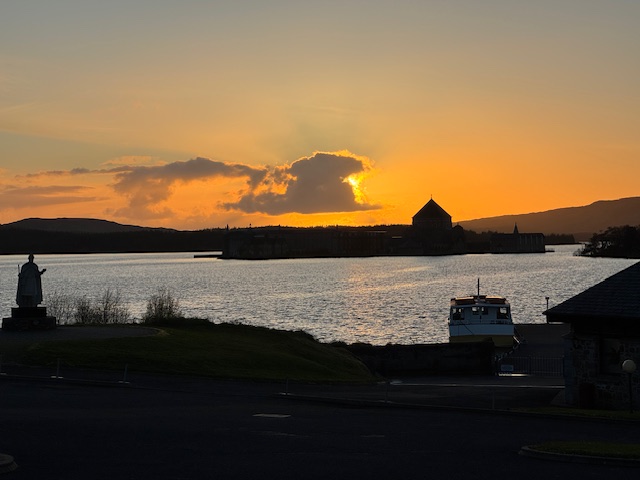
There is a lake in ancient Ulster, in County Donegal. Remote, windswept, sitting in a stretch of bogland that was old when the first people arrived and will be old when the last ones leave.
The water is black, the name means the Dark Lake. Lough Derg.
She was here before any monastery, before any pilgrim, before any saint arrived with certainties and a new god.
In ancient Ireland the goddess took many forms. Crane at the water's edge. Serpent in the darkness below. The Druids did not find this contradictory. They understood that the sacred feminine could not be held in a single shape — that to try was to misunderstand it entirely.
Then St Patrick arrived.
Corra spat fire into every well and stream as she retreated — not fleeing but fighting, poisoning the water behind her to slow him down, to keep him thirsty, to defend what was hers. They fought for two days and two nights. At the edge of Lough Derg he drove her into a cave beneath the water. Undefeated. She went below.
St Patrick called her Corra — Mother of Demons.
Where the old gods lived, the new ones built. Where the sacred had been, they planted their cross. Where she had been worshipped, they raised their walls. That which was not theirs was named evil.
On the islands of Lough Derg they built. First Saints Island — a monastery on ground the Druids had already made sacred. They named it Saints Island. She was already there.
The cave in the earth, sealed. The pre-Christian earthwork on its summit, older than any monastery, older than any saint. And underneath it all — undefeated, patient, with nothing but time and a long memory for those who built on her ground.
Strange sounds from the earth. Water rising where it shouldn't. Cattle disappearing from the surrounding farms. The old boatmen refusing to cross after dark.
The monks left. Quietly.
Coming in Cabhán na Caillí —
The Lake at Sunset — a first visit to Lough Derg.
The Cave — sealed since 1790, never excavated, beneath the bell tower on Station Island.
The Walk to Saints Island — alone, with a dog, on the old pilgrim path.
The Day on the Island — 22nd May.