The Mother of Demons Who Visits My Lake
She arrives without announcement.
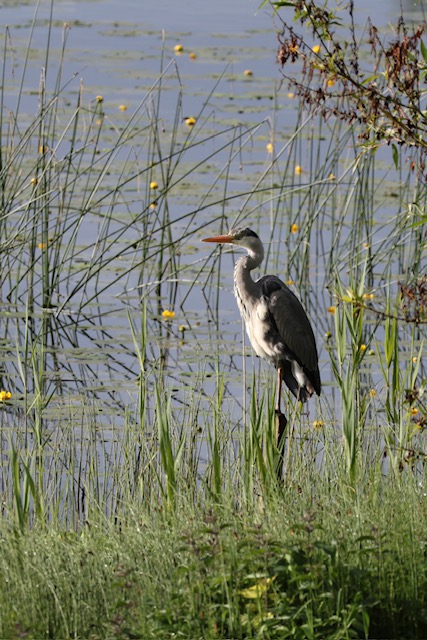
One morning she is simply there — standing at the edge of my small lake in County Fermanagh, absolutely still among the reeds and the yellow water lilies, as though she has always been there and it is I who am the newcomer. Grey-blue, ancient-looking, that long orange bill, those watchful eyes. She stands at the precise threshold between land and water, belonging wholly to neither. She stays for a while. Then she opens those great prehistoric wings and is gone, and the lake settles back into silence as though she was never there at all.
She has been coming here for years.
I never knew her name.
Her name is Corra — Kor-ra, two syllables, the r slightly rolled, a sound that belongs to running water. The Druids also knew her as Caoránach — Kweer-aw-nakh. She has worn many names across the centuries because she is many things at once. But it is Corra I keep returning to because it is the oldest, and because it means crane, or heron — that liminal water bird that stands at the edge of two worlds and belongs wholly to neither.
She is one of the oldest presences in Irish mythology. Not a minor sprite or a local legend — something vast and primordial. A goddess of the earth and water, of life, fertility, rebirth and ancient wisdom. The Druids revered the serpent and the dragon as sacred symbols of the feminine, of the Otherworld, of the deep knowledge that lives in dark places where ordinary life cannot reach. The serpent goddess appears across European mythology — blocking rivers, shaping land, holding the knowledge of life and death in her coiled body. Corra was Ireland's version of that oldest of all stories. Some say she was brought here by the Tuatha Dé Danann, that supernatural divine race who retreated into the hills and burial mounds when the world changed around them. Others say she was older even than that.
Saint Patrick called her the Mother of Demons.
He would, wouldn't he.
Her story is written into the Irish landscape in the most literal way possible. There is a lake in County Donegal — about a 1/2 hour's drive from where I live — that I have passed countless times without ever stopping to ask what it holds. Remote, windswept, sitting in a bleak and beautiful stretch of bogland. It is called Lough Derg.
The name means the Dark Lake, the Red Lake. And the redness, according to the oldest stories, is hers. It is Corra's blood in the water. This is where her story ends — or rather, where it refuses to end. Where Saint Patrick drove her into a cave beneath the lough and sealed her there, not dead but waiting, bound by faith and prayer.
The old boatmen on Lough Derg know she is still there. They say during storms you can see her tail lashing across the surface of the water.
I am going to go and find her.
Next: The Walk to Saints Island